
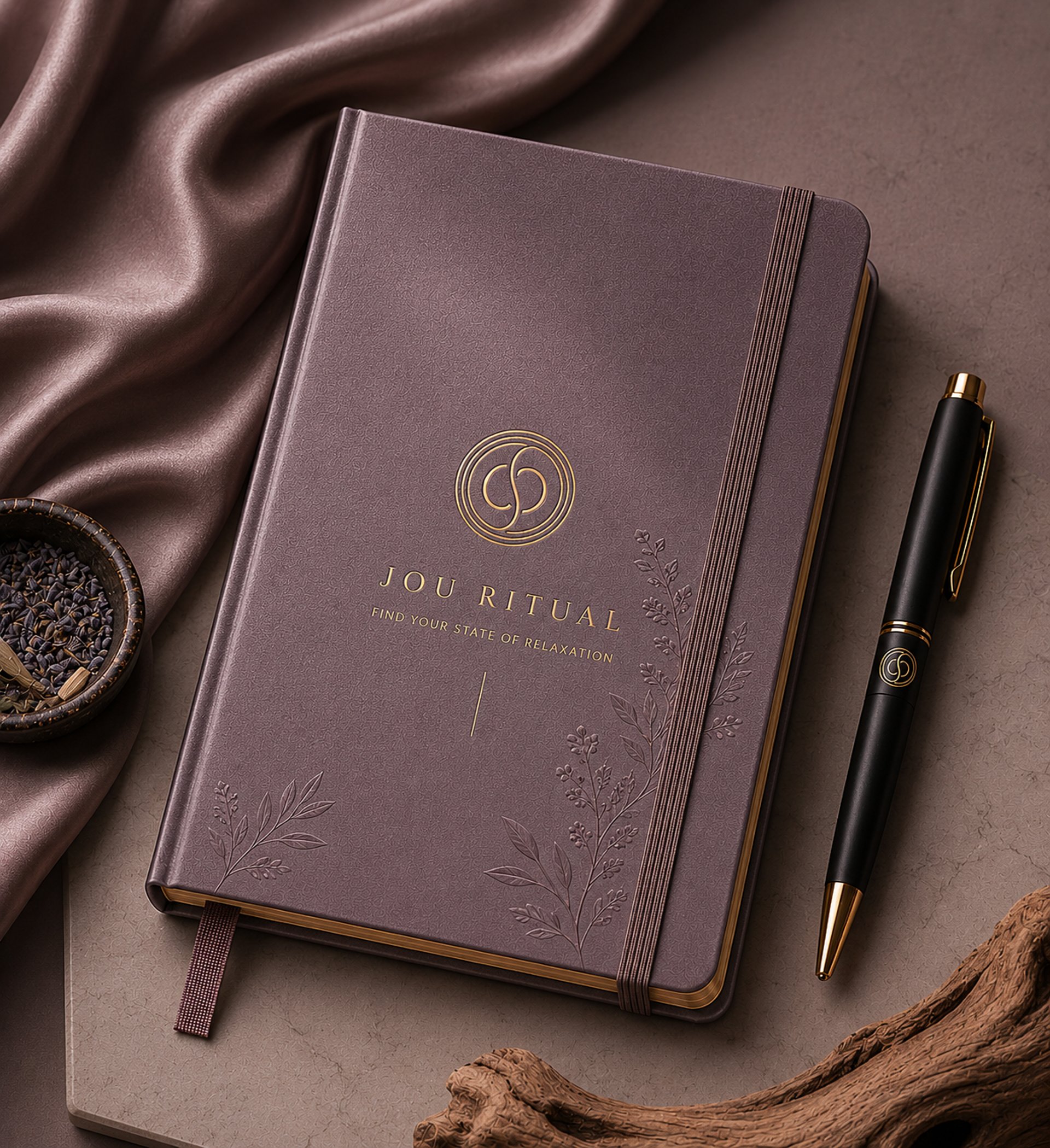
What holds you should feel livable.
Observations on exhaustion, beauty, nervous systems, modern loneliness, ritual, and emotional survival.
Written in English and Chinese.
Different languages carry different textures, but the intention remains the same.
Ritual Practice
What you return to becomes part of you
Consistency without force
The practices that last are rarely the most intense. They are usually the gentlest:
tea at night, skincare after exhaustion, a candle, silence, slow breathing, returning again without pressure.
Soft enough to return to
Not every ritual needs discipline. Some practices stay with us simply because they feel comforting enough to come back to.
Private, personal, imperfect
Ritual is not performance. It is the quiet relationship between your body, your emotions, and the small things that help you feel like yourself again.




Ritual psychology
The body remembers what feels safe enough to repeat.
The rituals that stay are rarely the loudest ones.
Usually, they are the quiet things repeated gently over time -一 wine at night, dim lighting, skincare after exhaustion, sitting still for a few extra minutes before sleep.
When something asks less from the nervous system, returning becomes easier.
Eventually, the ritual stops feeling like effort and starts feeling like home.
The work is private. The results compound.
Small rituals repeated gently over time begin to change the atmosphere of a life.
Not dramatically.
一 Quietly.
▼
READ
Tea as Ritual
Hope that whoever reads this finds their own version of that flow.
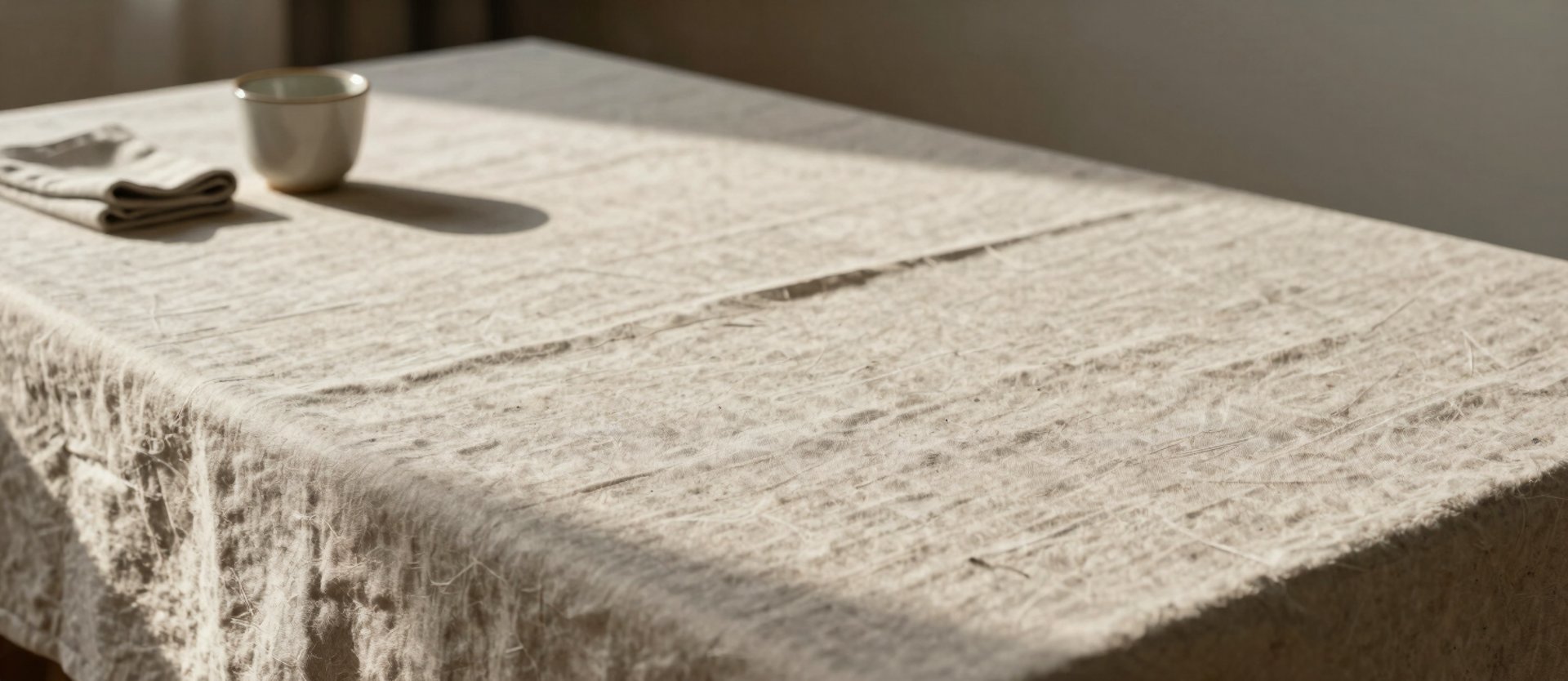
Tea has always carried a deep sense of ritual for me. Whether it’s Chinese tea culture, Japanese tea ceremony, or English afternoon tea, none of them feel like they are simply about drinking tea. To me, they are all different ways of slowing emotions down and returning attention back to the present moment.
What I love is not only the tea itself, but everything surrounding it — subtle conversations between people, playful humor, quiet pauses, the warmth of the cup, drifting aromas, rising steam, and the careful attention paid to timing and temperature. Somehow, through these small details, a calm and gentle flow state slowly begins to appear.
Chinese tea culture uses tea as a bridge between philosophy and daily life, blending Confucian, Taoist, and Buddhist ideas into a pursuit of harmony, stillness, ease, and authenticity. It feels less like a beverage ritual and more like practicing an inner rhythm.
Japanese tea ceremony, deeply influenced by tea master Sen no Rikyū, centers around the philosophy of harmony, respect, purity, and tranquility. It elevates tea preparation into a refined practice of hospitality, discipline, emotional grounding, and the beauty of wabi-sabi. More than technique, it becomes a philosophy for organizing the inner self through ritual.
English afternoon tea carries an entirely different kind of romance. At its heart is the idea of intentionally slowing down — stealing a small pocket of peace from modern life. Elegant tableware, soft sofas, delicate desserts, smoked salmon sandwiches, warm tea, and long conversations become a gentle way of creating rest and emotional recovery within busy routines.
My mother has always loved tea deeply. Our family still keeps an old stone grinder that she brought all the way from Taiwan to the United States. I’ve always loved it too, and I think of it as a family treasure. To me, it carries far more than practical use — it holds memory, emotion, and continuity.
When I was in high school, Japanese exchange students once visited our school and demonstrated traditional tea ceremony. It was my first formal introduction to it. At first, I carefully observed every movement and detail. But eventually, my attention slowly drifted to their knees. They stayed kneeling through the entire ceremony, and honestly, the only thought left in my mind was:
“Wait… aren’t their knees exhausted? ”At some point, my spiritual admiration quietly lost to concern for their knees.
Films and documentaries often portray Japanese tea ceremony with incredible beauty and spiritual depth. I genuinely admire it, though probably from a comfortable distance. I’ve accepted that I’m simply the type of person who prefers sitting in a chair.
In my twenties, I started going to English afternoon tea with friends. I loved the cakes, smoked salmon sandwiches, soft sofas, beautiful tea sets, and long afternoons spent talking. Those moments made me very happy. But looking back now, the afternoons I treasure most were always the ones shared with my mother.
These days, I feel myself slowly returning to the kind of flow state I had been searching for all along. Tea, to me, holds a uniquely personal sense of ritual. But perhaps the tea itself was never the most important part.
一Tea is only the medium. What truly matters is the feeling of emotions settling down, the body slowing naturally, and the quiet realization that you are fully present — focused, alive, and genuinely experiencing life again.
▼
CHINESE VERSON
茶
願讀到這段文字的妳,都能找到屬於自己的那種流動狀態。
對我而言,茶一向承載著一種深層的儀式感。無論是中國茶文化、日本茶道,還是英式下午茶,沒有一種讓我覺得單純只是在「喝茶」。在我的理解中,它們都是以不同的方式讓情緒慢下來,並將注意力重新帶回此時此刻。 我所迷戀的,不僅僅是茶湯本身,更是圍繞著茶而生的一切——人與人之間細微的對話、調皮的幽默、安靜的停頓、杯盞的溫熱、飄散的香氣、裊裊的蒸氣,以及對時間與溫度的悉心專注。不知怎地,透過這些微小的細節,一種沉靜而溫柔的流動狀態,便悄然浮現。
中國茶文化將茶視為哲學與日常生活的橋樑,將儒、釋、道三家的思想融為一體,追求「和、靜、怡、真」。這感覺不像是一場飲品的儀式,更像是在修煉一種內在的律動。
而深受茶聖千利休影響的日本茶道,則圍繞著「和、敬、清、寂」的哲學展開。它將沏茶的過程昇華為一種關於款待、紀律、情緒安頓與侘寂之美的精進實踐。這不僅僅是技藝,更成了一種透過儀式來整理內在自我的哲學。英式下午茶則攜帶著完全不同的一種浪漫。其核心在於「刻意慢下來」的起心動念——從現代生活裡偷得一小塊寧靜的口袋。精緻的餐具、柔軟的沙發、細緻的甜點、煙燻鮭魚三明治、溫熱的茶湯與綿長的對話,成為了在忙碌日常中,創造休息與情緒修復的溫柔方式。
我的母親一直以來都極其愛茶。我們家至今仍悉心保存著一台老石磨,那是她當年一路上從台灣大老遠帶到美國來的。我也一直非常鍾愛它,並將它視為我們家的傳家之寶。對我來說,它承載的遠遠超過實用價值——它裝著記憶、情感,以及血脈的延續。
高中的時候,曾有日本交換學生來到我們學校,並當場示範了傳統茶道。那是我第一次正式接觸它。一開始,我非常認真地觀察他們的每一個動作與細節。但漸漸地,我的注意力慢慢飄向了他們的膝蓋。在整場儀式中,他們全程保持著正坐(跪坐)的姿態,說實話,當時我腦海中剩下唯一的念頭就是:「等等……他們的膝蓋難道不累嗎?」 在某個瞬間,我內心那份精神上的崇敬,悄悄敗給了對他們膝蓋的擔憂。
電影和紀錄片常常把日本茶道拍得極具美感與精神深度。我是由衷地欣賞它,不過,大概是保持在一種舒適的距離之外。我已經接受了自己就是那種「更喜歡坐在椅子上」的人。 二十幾歲時,我開始和朋友們一起去喝英式下午茶。我愛那些蛋糕、煙燻鮭魚三明治、柔軟的沙發、美麗的茶具,以及消磨在聊天中的漫長午後。那些時刻曾讓我感到無比快樂。但如今暮然回首,我最珍視的午後,卻始終是那些與母親一起共度的時光。
這些日子,我感覺自己正慢慢回到了那種我一直在尋找的流動狀態。茶,對我而言,擁有一種獨特且極其私人的儀式感。但或許,茶本身從來都不是最重要的部分。
—茶,僅僅是媒介。真正至關重要的,是情緒沉澱下來的宿命感,是身體自然放慢的節奏,以及那份安靜的覺察:妳正全然地安於當下
—專注著、鮮活著,並真正重新在體驗生命。
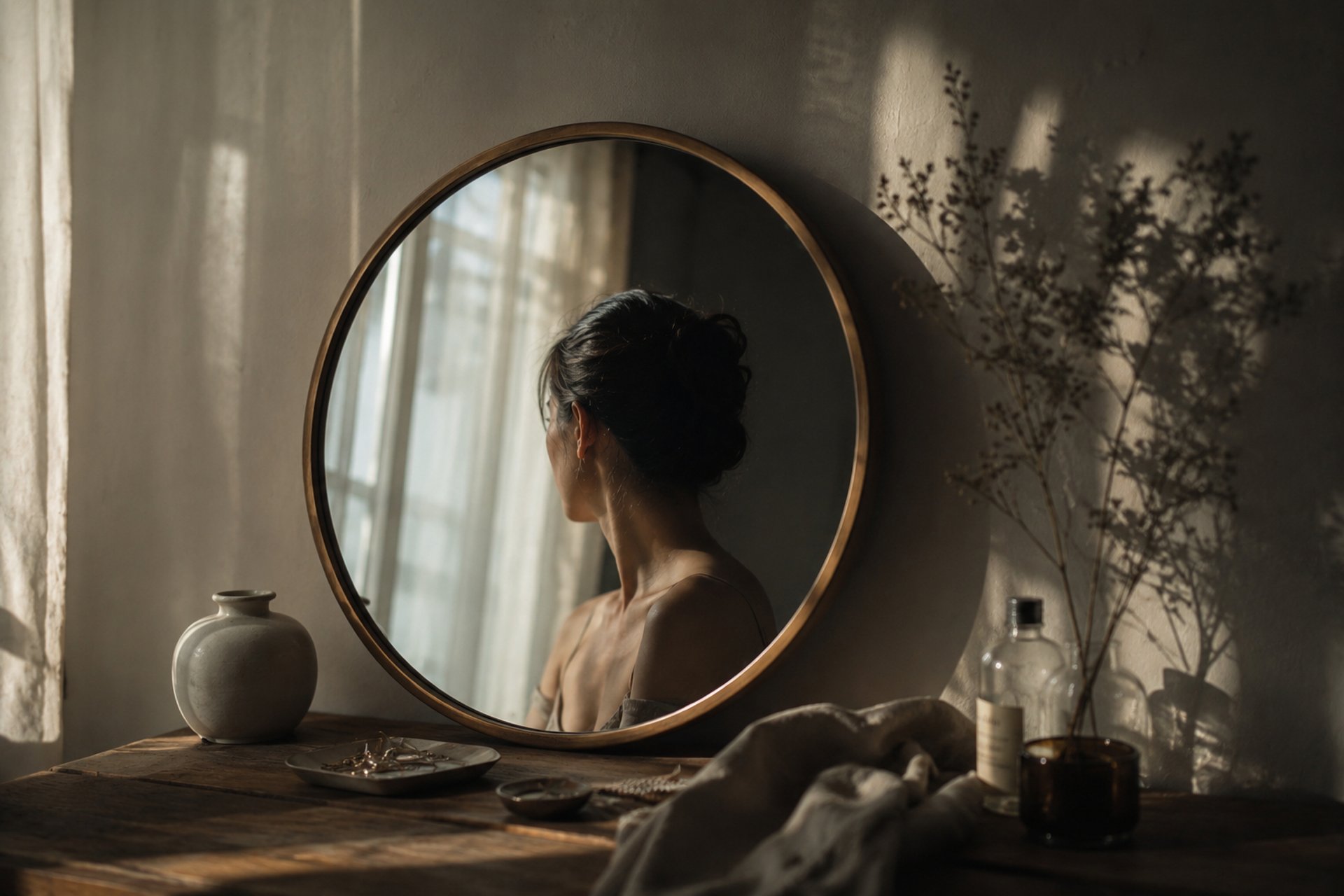
When the Mirror Changes
I Don’t Feel Like Myself Anymore. Not because she disappeared. But because she is becoming someone new.
For a long time, I wanted to write about menopause. But every time I tried, the subject felt too vast, too complex—too deeply human.
Because this is not a story about hormones.
It is a story about identity. This is not a medical archive. I will not be discussing estrogen, soy isoflavones, black cohosh, supplements, HRT, or even acupuncture—though all of these have their place.
What I want to talk about is something much quieter.
What happens when a woman stands naked in front of a mirror and truly studies herself?
Not just for a fleeting moment, but for a long, heavy silence.
And the thoughts begin to arrive:
“I am losing my radiance.”
“My body doesn’t feel like my own anymore.”
“I don’t want him to touch me.”
“Why do I suddenly long for someone else to hold me?”
“What if one day he leaves?”
“Should I alter myself?”
“Should I fix what is broken?”
Nobody speaks of these thoughts, but they exist. And they are often far more agonizing than the hot flashes.
To the woman moving through menopause.
To the woman whose children have grown and left the nest.
To the woman rebuilding her life after a divorce.
To the woman carrying old wounds that still ache at the slightest touch.
I see you. You have spent a lifetime caring for everyone else.
Mother, partner, professional, caregiver, leader, problem-solver—always the strong one.
And then one day, your body whispers:
“I’m tired.”
“I can’t carry it all anymore.”
“Something has to change.”
Suddenly, the strategies that once served you no longer work. Pushing harder doesn’t help. Ignoring it doesn’t help. Pretending doesn’t help.
Maybe the answer is not to fight harder.
Maybe the answer is not to keep going.
Maybe the answer is simply to allow.
To let it flow— The pain, the desire, the body, the fever, the anger, the memories, the resentment. Not because they define who you are, but because they need somewhere to go. This is not surrender. It is release.
When we stop forcing every difficult feeling to disappear, something unexpected happens. We begin to hear our own voice again. Beneath the noise. Beneath the roles. Beneath the expectations.
The woman who was always there— Waiting. Not to become someone new, but to return to herself.
▼
CHINESE VERSON
鏡中的那個自己
我不再覺得自己像自己了。並非因為「她」消失了,而是因為,她正在蜕變成一個全新的人。
長久以來,我一直想寫寫關於更年期的故事,但每次試圖動筆,總覺得這個主題太過龐大、太過複雜——它攜帶著太深太重的人性。
因為,這從來不是一個關於荷爾蒙的故事, 這是一個關於「身份認同」的故事。這不是一份醫學文獻,我不會在這裡討論雌激素、大豆異黃酮、黑升麻、營養補充品、荷爾蒙替代療法(HRT),甚至不會討論針灸 —儘管這些方法在各自的領域都發揮著作用。
我想聊聊的,是一些更為安靜的事:當一個女人一絲不掛地站在鏡子前,真正、仔細地審視自己時,會發生什麼?
不只是匆匆瞥過,而是在漫長、沉重的寂靜中,久久凝視。那些思緒便開始排山倒海而來:
「我正在失去我的光彩。」
「我的身體感覺不再屬於我自己了。」
「我不想讓他碰我。」
「為什麼我突然渴望被另一個人擁抱?」
「如果有一天他離開了怎麼辦?」
「我應該去改變、去調整自己嗎?」
「我應該去修補那些已經破碎的東西嗎?」
沒有人會公開談論這些想法,但它們確實存在。而這些內心的自我懷疑,往往比身體的潮熱更加令人痛苦、折磨。
致那些正在經歷更年期的女人。
致那些孩子已經長大成人、搬離巢穴的女人。
致那些在離婚後努力重組生活的女人。
致那些身上帶著陳年舊傷、稍微一碰就隱隱作痛的女人。
我懂妳。妳花了一輩子的時間,去照顧身邊的每一個人。母親、伴侶、職場專業人士、照護者、領導者、問題解決者,妳永遠是那個堅強的人。
然後有一天,妳的身體突然發出微弱的耳語:「我累了。」
「我再也扛不動這一切了。」
「有些東西,必須改變。」
突然之間,那些曾經保護過妳的生存策略,再也不管用了。逼自己更努力沒有用。假裝不在意沒有用。演得自己若無其事,也沒有用。
也許,答案從來就不是去更用力地對抗。
也許,答案不是硬著頭皮繼續走下去。
也許,答案僅僅是 : 允許。
允許這一切流淌出來— 那些痛苦、那些渴望、這具身體、這場熱病、那些憤怒、記憶與怨懟。
不是因為這些東西定義了妳是誰,而是因為,它們需要一個出口。
這不是認輸,這是釋放。當我們不再強迫每一種痛苦的情緒都必須立刻消失時,意想不到的事情發生了。我們開始在噪音底下、在那些角色背後、在所有的期待之中,重新聽見自己真正的聲音:那個一直都在的女人。 一直在那裡,靜靜地等待,不是為了變成一個全然陌生的人,而僅僅是,重新回到自己。

The Cost of Being Seen
As the world grows louder and more overwhelming, may the person reading this be treated gently by the world.
After watching a BTS concert, I suddenly found myself thinking about how, when people talk about the Korean entertainment industry, the first things they usually see are the stage, the makeup, the bodies, the lights, the fame, and the screaming crowds.
But over time, I started realizing that what truly exhausts people may not just be the work itself, but the experience of being constantly seen.
Some people gain fame.
Some people gain fortune.
Some people finally feel seen by the world.
But at the same time, some begin to wonder: Without the stage, the filters, or the role they perform, what is actually left of them? This is not an article trying to expose some hidden dark side of the industry.
I’m not part of the entertainment world, and I don’t have the authority to claim I understand how that system truly operates behind the scenes. But after working in Korean clinics and within high-pressure Asian beauty and wellness environments, certain emotional patterns began to feel strangely familiar to me.
That constant need to appear: professional, attractive, stable, productive. Even when exhausted, you must not look exhausted. Even when emotions are overflowing, you must remain composed. Eventually, I realized this is not only a Korean cultural phenomenon. Many countries, many industries, and even ordinary everyday life are slowly becoming more and more like this. Sometimes I feel that modern people, in some way, are all beginning to live a little like idols.
We learn how to manage our image.
We learn how to control our emotional output.
We learn how to present personalities that are suitable for being watched online.
Even rest itself slowly becomes another kind of performance. Part of what makes Korean pop culture so captivating is not only that it perfects emotion, aesthetics, rhythm, lighting, and the feeling of youth. It is also because the industry learned very early on how to systematically combine emotion, beauty, idol personas, internet culture, and fan psychology into something incredibly powerful. And because of that, the level of discipline, emotional endurance, and personal sacrifice required behind the scenes is often far greater than most people imagine.
Then one late night, I suddenly realized: In this overstimulated world — where everyone is always online, always visible, always being watched —Perhaps many people are simply trying their best not to fall apart too obviously.
▼
CHINESE VERSON
被看見的代價
當世界變得越來越喧囂、越來越令人不知所措,願讀到這段文字的妳,都能被這個世界溫柔以待。
看完一場 BTS 演唱會後,我突然陷入了沉思。每當人們談論起韓國娛樂產業時,首先映入眼簾的通常是耀眼的舞台、精緻的妝容、完美的完美身材、斑斕的燈光、巨大的名聲,以及台下瘋狂尖叫的群眾。 但隨著時間推移,我開始意識到,那些真正讓人感到精疲力竭的,或許不僅僅是工作本身,而是那種「無時無刻不被注視」的體驗。
有些人贏得了名聲。
有些人獲得了財富。
有些人終於感受到了被世界看見的滋味。
但與此同時,也有人開始在心底暗自思忖:如果褪去了舞台、濾鏡,或是那些他們所扮演的角色,他們真正的自我,究竟還剩下什麼?這並不是一篇試圖揭露娛樂圈背後所謂陰暗面的文章。我並不屬於娛樂圈,也沒有資格聲稱自己真正了解那個系統在幕後是如何運作的。然而,在韓國體系的診所,以及高壓的亞洲醫美與健康環境中工作過後,某些情緒模式開始讓我感到一種奇特的熟悉感。 那種必須讓自己時刻保持在專業、迷人、穩定、高效的持續需求。
即使精疲力竭,也絕不能顯露出疲態。 即使情緒早已泛濫成災,也必須維持著得體的從容。 最終我發現,這不僅僅是一種韓國的文化現象。在許多國家、許多產業,甚至在平凡的日常生活中,一切都在悄然變得越來越像這樣。有時候我覺得,現代人在某種程度上,都開始活得有點像「偶像」了。
我們學會了如何管理自己的形象。
我們學會了如何控制自己的情緒輸出。
我們學會了如何在網路上,呈現出那些適合被觀看的人設。 甚至連「休息」這件事,都慢慢演變成了另一種形式的表演。
韓國流行文化之所以如此令人著迷,部分原因不僅在於它將情緒、美學、節奏、燈光以及青春感雕琢到了極致;更因為這個產業很早就學會了如何系統化地將情感、美麗、偶像人設、網路文化與粉絲心理,組合成一種無比強大的力量。也正因如此,在那些光鮮亮麗的幕後,每個人所被要求的紀律、情緒耐受力以及個人犧牲,往往遠遠超出了大多數人的想像。
然後,在某個深夜裡,我突然恍然大悟: 在這個過度刺激的世界裡——在每個人都時刻在線、時刻曝光、時刻被注視的當下——
或許許多人,不過是在拼盡全力,讓自己崩潰得不那麼明顯罷了。
The JOU Trilogy | The spine of The JOU Trilogy. On Space, Stewardship, and Legacy
Some inheritances are wealth. Some are land. Some are family names. And some are a way of seeing the world.
The JOU Trilogy is not a story about success, nor is it a story about entrepreneurship. It is the story of how a spirit is created, protected, and ultimately transformed into new life. At its heart, this is a story about space: a library, a door that remained open, and a new kind of sanctuary born in a different era.
Part I, The Man Who Trusted Mathematics, tells the story of a mathematician’s stubbornness and vision. When others saw a marketplace, he saw a missing piece of civilization. When others pursued profit, he chose preservation. When others walked away, he stayed. In the early days of the internet, he believed that reading deserved to be preserved, knowledge deserved to be organized, and culture deserved long-term stewardship. So he built Haodoo. Not to become an entrepreneur, not to disrupt an industry, but because he believed that some things are worth preserving even when they are never profitable. On the surface, he built an electronic library. In truth, he built a space for reading—a digital library for Chinese readers around the world. This first volume asks a simple question: What kind of person builds a library before the world realizes it needs one? Because he trusted, he began.
Part II, The Woman Who Kept Going, is a story of resilience and responsibility. Ideas can ignite a flame, but responsibility is what keeps it burning. Every vision eventually encounters reality. Bills must be paid. Life must be lived. Time must be endured. When the builder was gone, the true test began. She did not build the library, but she kept it alive. After the librarian could no longer stand at the door, she continued opening it each day. Readers could still enter. The shelves still remained. The lights never went out. What she protected was not merely a website or a collection of books, but a person’s dream, a community’s memory, and a cultural legacy belonging to an entire generation. This volume asks: What kind of person keeps a library alive after its builder is gone? Because she kept it, it did not disappear.
Part III, The Lady Who Built a Different Space, is a story of transformation and creation. She did not remain inside the library, nor did she simply repeat the path of the generation before her. Instead, she carried the spirit forward into a different world. What she inherited was not a website, software, or a business model, but a set of values: her father’s devotion to structure, her mother’s devotion to responsibility, and an unwavering belief that certain spaces matter. Through healing, stories, words, ritual, and genuine human connection, she began building a place of her own. Not a digital library, but a different kind of space. In a fast-moving, anxious, and noisy world, she sought to create a place where people could pause, reflect, recover, and reconnect with themselves. What she built was not a brand or a product, but an experience—a space where people can read, reflect, heal, and return to who they are. That space is called JOU RITUAL. This final volume asks: What happens when a legacy becomes a creation? Because it endured, something new could be built.
Together, the trilogy traces a spiritual journey: Trusted → Kept → Built. Trust → Stewardship → Creation. Idea → Responsibility → Creation.
A man built a library. A woman kept its doors open. A lady built another space. And the spirit continued.
Dr. Jou left behind a space for reading. Lady Yulin kept that space alive. And through JOU RITUAL, I seek to create another space—a place for reflection, healing, storytelling, and human connection.
This is not a repetition of their lives. It is the continuation of their spirit. Because some things are worth preserving. Some things are worth protecting. And some things deserve to be reimagined by the next generation.
▼
CHINESE VERSON
周氏三部曲結構:關於空間、守護與傳承。
有些遺產是財富,有些遺產是土地,有些遺產是姓氏,而有些遺產,則是一種看待世界的方式。《周氏三部曲》並不是關於成功,也不是關於創業。它講述的是一種精神如何被創造、被守護,最終被重新轉化成新的生命。
這是一個關於空間的故事:一座圖書館、一扇始終敞開的大門,以及一個在新時代誕生的全新空間。
第一部《The Man Who Trusted Mathematics》講述一位數學家的固執與遠見。當許多人看見市場時,他看見的是文明的缺口;當許多人追逐利潤時,他選擇保存價值;當許多人離開時,他選擇留下。在網際網路尚未成熟的年代,他相信閱讀值得被保存,知識值得被整理,文化值得被長期維護。於是,他建立了好讀。不是為了成為企業家,不是為了改變產業,而是因為他相信:有些東西,即使不賺錢,也值得存在。表面上,他建立的是電子書平台;更深層地說,他建立的是一個閱讀空間,一座屬於全球華文讀者的數位圖書館。這一部試圖回答一個問題:究竟是怎樣的人,會在世界意識到需求之前,就先為它蓋好一座圖書館?因為相信,所以開始。
第二部《The Woman Who Kept Going》講述一個女人的堅韌與承擔。思想可以點燃火焰,但責任才能讓火焰持續燃燒。所有的理想終究都會遇見現實,帳單要支付,生活要經營,時間要熬過,歲月要承受。當建造者離開之後,真正的考驗才開始。她沒有建立圖書館,但她守住了圖書館。當館長離開後,她依然每天把大門打開,讓讀者能夠進來,讓書架依然存在,讓燈光沒有熄滅。她守護的不只是網站與書籍,而是一個人的理想、一群讀者的記憶,以及一個時代的文化資產。這一部試圖回答另一個問題:究竟是怎樣的人,能在建造者離開之後,依然讓這座圖書館活著?因為守住,所以不滅。
第三部《The Lady Who Built a Different Space》講述一個女兒的蛻變與創造。她沒有停留在圖書館裡,也沒有複製上一代的道路。她帶著同樣的精神走向不同的世界。她繼承的不是網站,不是軟體,不是商業模式,而是一種價值觀:父親對結構的堅持、母親對責任的承擔,以及那份始終相信「空間能夠改變人」的信念。於是,她開始建造自己的地方。不是數位圖書館,而是另一種空間。透過針灸、療癒、故事、文字、儀式,以及人與人之間真誠的連結,她試圖在這個快速、焦慮且充滿噪音的時代,創造一個讓人得以停下腳步的地方。她真正建造的不是品牌,不是產品,而是一種體驗;一個讓人閱讀、思考、修復與重新找回自己的空間。那個空間,叫做 JOU RITUAL。這一部試圖回答最後一個問題:當一份被守護下來的信念,最終化為一場全新的創造,會發生什麼事?因為不滅,所以創造。
三部曲共同描繪了一條精神的軌跡:Trusted → Kept → Built;相信 → 守護 → 建造;思想 → 責任 → 創造。
一個男人建立了一座圖書館,一個女人守住了圖書館的大門,一位女士建造了另一個空間。而那份精神,仍然繼續前行。
周博士留下了閱讀的空間,喻琳女士守住了閱讀的空間,而我,則在 JOU RITUAL 裡建造另一個讓人停留、思考、療癒與重新找回自己的空間。
這不是重複他們的人生,而是延續他們的精神。因為有些東西值得被保存,有些東西值得被守護,而有些東西,值得在下一個世代被重新創造。
The JOU Trilogy
Part I: The Man Who Trusted Mathematics
Theme: Ideas
Dr. Jou was a mathematician. He possessed the logic, persistence, and foresight often associated with mathematicians. While much of the world chased markets, capital, and commercial opportunity, he noticed something else: the cultural gaps left behind by rapid technological change. Driven by a lifelong love of reading and a deep trust in logic, discipline, and order, he built the Haodoo digital library with his own hands.
It was a very different era. PDAs held only a few megabytes of memory, mobile phones still had physical buttons, and reading long-form literature on a screen was far from common. Yet even then, Dr. Jou was already imagining a different future.
Born with a love for novels, he spent much of his life moving between countries and cities. Carrying large collections of books was difficult, and for several years he could not easily find traditional Chinese literature overseas. He turned to English novels instead, often finishing a book every week. During those years, a simple question began to form in his mind: What if an entire library could fit into a pocket?
The first version of Haodoo grew from that question. At the time, no e-book platform offered the traditional vertical Chinese layout he loved. Unable to find the reading experience he wanted, he decided to create it himself. The birth of Haodoo was never driven by a business plan, a startup dream, or market analysis. It came from something much simpler: a reader's desire to preserve the books he loved. He believed that some things remain worth preserving, even if they never generate profit. So he built a library.What kind of person builds a library before the world realizes it needs one? Because he could not find it, he built it. That is his story.
Over the years, the library faced many challenges. There were financial realities, technological limitations, criticism from others, and ongoing questions about sustainability. There were moments of frustration and disappointment, yet Dr. Jou always focused on the larger picture. At the heart of his thinking was a belief that guided much of his life: rules are not permanent. Rules are created, and rules can be changed.
Many people read his writings today as commentary on technology and digital publishing. As his daughter, I see something deeper. Those words reflected the way he viewed the world itself. A mathematician does not simply accept a framework because it already exists. When presented with an answer, he asks another question: Must it be this way? Is there another proof? Is there another solution? Because he believed in reading, he built a library. Because he believed in the future, he refused to close its doors. Because he believed that rules would eventually change, he was willing to wait.
What made Dr. Jou remarkable was not simply that he created a digital library. It was that after years of skepticism, difficulty, and isolation, he still chose to keep it alive. He believed that some things are worth preserving, even when they are not profitable. Some rules, though unchanged today, will eventually be rewritten. Some ideals, though misunderstood now, remain worth waiting for.
This is the story of Dr. Jou, and it is also the most elegant proof he left behind. Yet no library survives because of its builder alone. As years pass, as creators grow older, and as ideals face the long test of time, someone must remain at the door. Within the digital library Dr. Jou created, there was such a person. She was not the builder, but she was the one who kept the doors open.
— To Be Continued
Part II: The Woman Who Kept Going
▼
CHINESE VERSON
The JOU Trilogy | 周氏三部曲
第一部:一個深信數學的男人
核心:思想(Ideas)
周博士是一位數學家。他擁有數學家特有的邏輯、堅持與遠見。當許多人追逐市場、資本與商機時,他看見的卻是科技快速發展之後所留下的文化缺口。憑藉對閱讀的熱愛,以及對邏輯、紀律與秩序的深刻信任,他親手創造了「好讀」數位圖書館。
那是一個截然不同的年代。PDA 的記憶體只有幾 MB,手機仍然使用按鍵設計,人們尚未習慣在螢幕上閱讀長篇文字。然而,即使在那樣的年代裡,周博士已經開始想像另一種未來。周博士天生喜歡閱讀小說,一生輾轉於不同城市與國家之間。對經常移動的人而言,攜帶大量實體書並不容易。有好幾年時間,他甚至難以取得繁體中文書籍,只能改讀英文小說,而且幾乎維持著一週一本的閱讀速度。在那些長年累月的閱讀時光裡,一個簡單的問題逐漸在他心中成形:如果有一天,整座圖書館都能被放進口袋裡呢? 好讀的第一個版本,便誕生於這個念頭。
當時市場上並不存在符合他期待的電子書系統。對周博士而言,中文閱讀最理想的形式仍然是傳統直排版面。然而,他找不到任何能夠呈現這種閱讀體驗的工具,於是決定自己動手完成。 好讀的誕生,從來不是來自商業計畫、創業夢想或市場分析。它源自一個閱讀者最單純的願望——保存自己所喜愛的書籍。他相信,有些東西即使無法帶來利潤,依然值得被保存。於是,他建造了一座圖書館。
究竟是什麼樣的人,會在世界尚未意識到需求之前,就先替它蓋好一座圖書館?答案其實很簡單:因為找不到,所以自己建造。這就是屬於周博士的故事。多年來,好讀面臨過許多挑戰。有現實的經濟壓力,有技術上的限制,也有來自外界的質疑與不理解。有過失望,也有過灰心,但周博士始終把目光放在更長遠的地方。在他的思想裡,有一個貫穿一生的核心信念:規則並非永恆不變,規則是被創造出來的,而規則也終將被改變。
許多人今天閱讀他留下的文字時,習慣將其視為科技評論。然而身為女兒,我知道那不只是對科技的評論,而是他看待世界的方式。真正的數學家從不因為一個框架已經存在,就認定它永遠正確。當世界遞給他一個答案時,他總會繼續追問:一定如此嗎?有沒有另一種證明?有沒有另一種解法?因為相信閱讀,所以他建造圖書館;因為相信未來,所以他不願關閉圖書館;因為相信規則終將改變,所以他願意在漫長的歲月裡耐心等待。
真正讓周博士與眾不同的,並不只是他創造了一座數位圖書館,而是在經歷多年質疑、困頓與孤獨之後,他依然選擇讓那座圖書館繼續存在。他相信,有些東西即使無法獲利,依然值得保存;有些規則即使今天尚未改變,終將被重新書寫;有些理想即使此刻不被理解,也依然值得等待。這是周博士的故事,也是他留給世界最優雅的一道證明。
然而,任何一座圖書館的存在,都不只是因為建造者。當歲月流逝,當創造者逐漸老去,當理想開始面對時間最漫長的考驗時,總還需要有人守著那扇門。而在周博士所創造的數位圖書館裡,確實有這樣一個人。她不是建造者,卻是那個讓圖書館持續亮著燈的人。
—— 待續:《第二部:那位始終向前走的女人》
The JOU Trilogy | 周氏三部曲
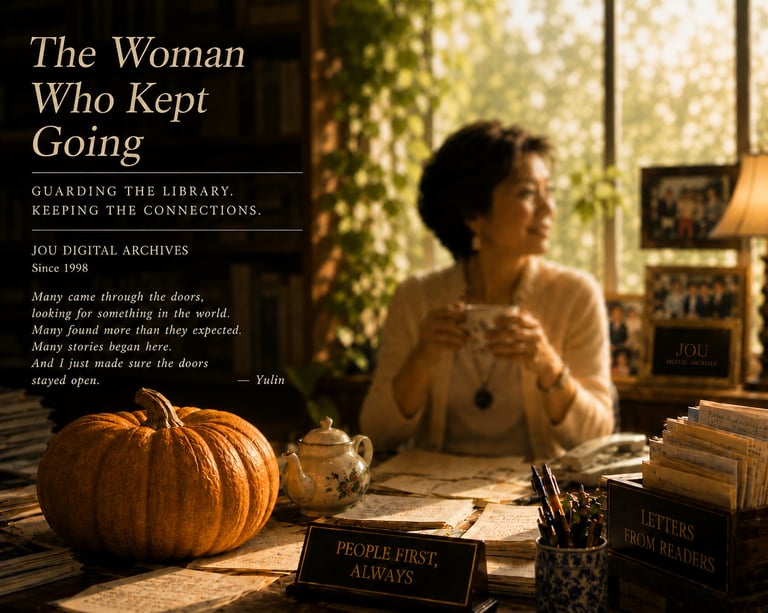
Part II: The Woman Who Kept Going
Theme: Resilience
Some people spend a lifetime building one thing. Others spend a lifetime moving through many things.
Yu-Lin belonged to the latter. Her life was never a straight road but a series of remarkable turns. From rural Taiwan to Taipei, from business to real estate, from love to marriage, from entrepreneurship to immigration, from family to Books.com.tw, and through the passing of time, each turn felt like opening a new chapter of a book. Somehow, she always found a way to keep moving forward.
Yu-Lin was born in rural Taiwan. Among six siblings, she was often the most popular one. She was not the delicate, melancholy heroine often found in literature. Her beauty carried the warmth of sunlight—bright, confident, and full of life. She naturally drew people toward her, had a gift for turning strangers into friends, and brought energy into every room she entered.
Some admired her, some envied her, and some never forgot her. She was never someone who went unnoticed. As a young woman, Yu-Lin moved to Taipei to study business and accounting. She believed opportunities rarely arrived on their own; they had to be discovered. She often saw possibilities before others did. Sometimes those possibilities were business ventures, sometimes real estate opportunities, sometimes new cities, and sometimes new encounters.
She approached life with curiosity, observing the world around her before deciding whether to step forward and explore it. Over the years, she ran businesses, founded companies, and invested in real estate. She experienced prosperity and hardship, success and failure. She bought jewelry, Rolex watches, and Mercedes-Benz cars, but she also experienced the inevitable rises and falls that accompany any long life. Yet regardless of circumstance, she never stopped moving forward.
Later, she met Dr. Jou, a man who believed deeply in mathematics, reading, and ideas. They were very different people. Dr. Jou believed in knowledge, structure, and systems, while Yu-Lin believed in people, opportunity, and action. One looked toward distant horizons while the other stood firmly on the ground. One built a library, while the other built a life around it.
Despite their differences, they spent decades together. They experienced entrepreneurship, immigration, family life, and the changing times. Together, they witnessed the birth and growth of HAODOO.NET.
If Dr. Jou built a library, then Yu-Lin provided the warmth and light that accompanied it through the years. As technology changed, as the world changed, and as reading habits evolved, she continued supporting the space in her own way, helping readers find their way through its doors. She never wrote code, designed systems, or built the website's architecture. Yet a library requires more than a builder; it also needs someone willing to stay beside it as time moves forward.
Years passed, people came and went, and the world continued to change. Eventually, Yu-Lin entered another chapter of her life. She began practicing Tai Chi and learned to enjoy slow afternoons filled with sunlight, tea, and conversations with friends. She still loved meeting people, sharing stories, and carried the same remarkable vitality that had followed her throughout life.
Time may have taken many things, but it never took away her light. Looking back on her life, what I admire most is not her success, nor the things she once owned. It is the way she continued moving forward regardless of circumstance. She understood when to pause, when to observe, and when to act. She always found a new direction after every turn and always managed to enter the next chapter of life with curiosity, energy, and authenticity.
Many people remember Dr. Jou because he built a library platform. I remember Yu-Lin because she taught me something equally important: life will not always be smooth, success is never guaranteed, and not every decision will be correct. Yet no matter what happens, it is always possible to begin again.
Throughout her life, she experienced prosperity and hardship, gain and loss, achievement and disappointment. Yet she never stopped moving forward, never stopped believing in tomorrow, never stopped believing in opportunity, and never stopped believing that life was worth continuing.
The Woman Who Kept Going — dedicated to the woman who never stopped moving forward.
▼
CHINESE VERSON
The JOU Trilogy | 周氏三部曲
第二部:那位始終向前走的女人
Core Theme: Resilience(生命力)
有些人用一生建造一件事, 有些人用一生穿越許多事,喻琳屬於後者。她的人生從來不是一條筆直的道路,而是一連串精彩的轉彎。
鄉下、台北、生意、房地產、愛情、婚姻、創業、移民、家庭、好讀,以及歲月。 每一次轉彎,都像翻開一本新的書,而她總能繼續往前走。
喻琳出生於台灣鄉下,六個兄弟姐妹之中,她是最受歡迎的那一個。 她不是那種文學作品裡憂鬱纖細的林黛玉。
她的美像一道陽光,美的很正氣。明亮、溫暖,充滿生命力,她總能在人群之中發光,也總能輕易地與陌生人成為朋友。
有人喜歡她、有人欣賞她、有人嫉妒她、也有人永遠忘不了她。因為她從來不是一個沒有存在感的人。
年輕時的喻琳來到台北,學習商業與會計。她相信人生不會主動送上機會,機會必須自己去發現。
她總是比別人更早看見可能性,有時候是生意,有時候是房地產,有時候是一個新的城市,有時候是一段新的相遇。
她總是帶著好奇心觀察世界,然後決定要不要走過去看看。她做過生意。開過公司。投資過房地產。
她見過繁華 、也見過低谷。 見過成功、也見過失敗。 她買過珠寶、勞力士與賓士。也經歷過人生的起伏與轉折,然而無論順境逆境,她始終沒有停止前進。
後來,她遇見了周博士,那個深信數學、閱讀與理想的男人。他們是兩個完全不同的人。周博士相信思想。喻琳相信人生。
周博士相信邏輯與結構。喻琳相信人、機運與行動。一個仰望遠方。一個腳踏大地。 一個建造圖書館。 一個經營生活。
他們如此不同,卻一起走過了漫長的人生歲月,一起經歷創業、移民、家庭與時代的變遷,也一起見證了好讀的誕生與成長。
如果說周博士建造了一座圖書館,那麼喻琳點著光與熱陪伴它走過了歲月。
當世界改變當科技改變,當閱讀習慣改變,她依然用自己的方式守護著這個地方,讓讀者能夠進來。
讓熟悉的燈光依然亮著,她沒有寫程式,沒有設計系統,也沒有建立網站架構。
然而一座圖書館的存在,從來不只需要建造者,也需要有人願意陪它一起走過時間。
歲月流轉,許多人來來去去,世界不斷改變,而喻琳的人生也迎來新的篇章。她開始上太極課,也享受陽光灑落的午後。
朋友喝茶聊天,開始用另一種節奏生活。她依然喜歡交朋友,依然喜歡與人分享故事, 依然保有那份旺盛的生命力。
彷彿歲月帶走了許多東西,卻始終帶不走她身上的光束,回頭看這位女人的一生,我最佩服的並不是她成功過,也不是她曾經擁有過什麼。
而是,無論人生如何變化。
她總是懂的停、看、接著行動。
她總能在轉彎之後找到新的方向。
她總能在人生的下一個階段,繼續活得熱鬧而真實。
許多人記得周博士,因為他建造了一座圖書館平台 ; 而我記得喻琳,因為她教會我:人生不一定永遠順利、不一定永遠成功、不一定每次選擇都正確。但無論發生什麼事,都可以重新開始。她的人生經歷過繁華,也經歷過低谷,經歷過得到。也經歷過失去。
然而,她始終沒有停下腳步。她始終相信明天。始終相信機會。始終相信人生值得繼續向前。“The Woman Who Kept Going." 致敬那位始終向前走的女人。



The JOU Trilogy
Part III: The Lady Who Built a Different Space
Theme: Transformation & Creation
If Dr. Jou built a library, and if Mrs. Yu-Lin Jou kept its doors open, then their daughter became something quite different: a complex introvert, a lifelong observer, and, unofficially, the leader of the Panda Society of Professional Underachievers.
At first glance, she seemed quiet, ordinary, and occasionally absent-minded. She was never particularly good at drawing attention to herself. As a teenager, she lacked confidence, felt awkward more often than not, and was rarely the center of attention. She was the type of student who sat quietly in the corner of the classroom, speaking very little while observing everyone else.
What most people didn't realize was that she spent much of her time watching. She watched people, relationships, emotions, and the stories hidden beneath everyday life. She was fascinated by why people became who they were and what experiences shaped their choices. Over time, she realized that people were far more complicated than they appeared, and eventually discovered that she was no exception.
Looking back, she came to understand something important. Her younger self seemed ordinary not because she lacked potential, but because her attention was focused elsewhere. While others were busy building identities, expressing themselves, and finding their place in the world, she was busy observing. She spent years trying to understand people, human nature, and the world around her, while spending very little time defining herself.
Later, she entered healthcare. There, she encountered hundreds of stories. She met people facing illness, grief, responsibility, exhaustion, uncertainty, and change. Although every story was different, the underlying questions were often remarkably similar. People were searching for safety, strength, understanding, connection, and a way to begin again.
She realizes those years of observation were never wasted. They accumulated quietly, like notebooks placed on a shelf or seeds waiting for the right season. The first half of her life was spent observing, collecting, organizing, and learning. The second half gradually became a process of expression.
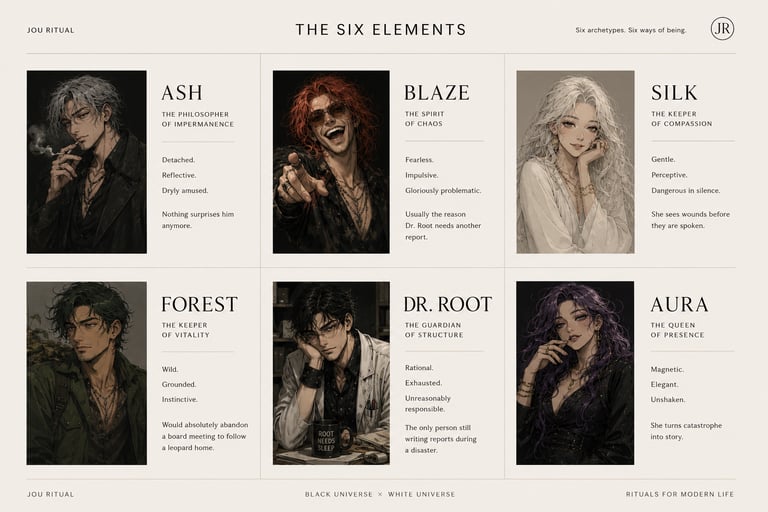
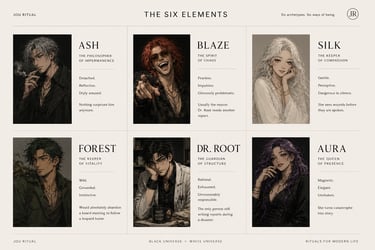
The people she observed, the questions she carried, and the emotions she struggled to describe eventually became stories. Those stories later evolved into Forest, Blaze, Ash, Silk, Root, and Aura. Some lives bloom quickly, while others require years of quiet development. They need time to observe, time to understand, and time to connect seemingly unrelated pieces into something meaningful.
Eventually, a new world emerged. It was not created out of imagination alone. It grew naturally from years of observing humanity, life itself, and eventually, herself.
If Dr. Jou left behind a space for reading, and if Mrs. Yu-Lin Jou preserved that space, then their daughter chose to build a different kind of space—a place where people could pause, reflect, breathe, recover, and reconnect with themselves.
From that vision came the Black & White Universe, Field Notes, late-night comics, stories, and eventually JOU Ritual. Within the Black & White Universe, she has another name: Aura.Not because she was born extraordinary, nor because she was more complete than anyone else, but because she finally learned how to gather the scattered pieces of herself and bring them home.
This is the final chapter of the Jou Trilogy. A man built a library. A woman kept its doors open. Another lady transformed years of observing humanity into a different kind of place—a place where people could pause, reflect, understand, and reconnect with themselves. That place is called JOU Ritual.
▼
CHINESE VERSON
The JOU Trilogy | 周氏三部曲
第三部:建造另一個空間的女士
Theme: Transformation & Creation (蛻變與創造)
如果周博士建立了一座圖書館,如果喻琳女士守住了圖書館的大門,那麼這位女兒,大體上是一位複雜型內向觀察者,同時也是廢材熊貓系幫主。
表面上看起來安靜、普通,甚至有些迷糊、懶散與慢半拍。她不特別擅長表現自己。青春期時既缺乏自信,也經常感到尷尬,不特別突出,也不是人群中的焦點。如果硬要形容,大概就是那種坐在教室角落、不太說話,卻默默觀察所有人的類型。
然而,她的大部分時間都在觀察:觀察世界、觀察人,也觀察自己。她喜歡思考人們為什麼會變成現在的樣子,喜歡研究一個人的選擇背後發生過什麼事,也喜歡理解那些無法被簡單定義的人性。多年以來,她逐漸發現,人類遠比表面看起來複雜,而自己,大概也是如此。
她慢慢理解了一件事:青春期的自己之所以顯得普通、安靜、缺乏自信,或許並不是因為缺少什麼,而是因為注意力始終放在別的地方。當許多人忙著建立自己、表現自己、尋找自己的位置時,她卻總是在觀察——觀察人、觀察關係、觀察情緒,以及那些沒有被說出口的故事。她總覺得,每個人的身上都藏著比表面更多的東西。於是,她花了很多時間理解世界、理解別人、理解人性,卻很少花時間定義自己。
後來,她進入醫療產業。在那些診療室與病歷之間,她看見更多的人。有人正在面對疾病,有人正在經歷失去,有人承受家庭責任,有人被工作消耗,也有人努力活成所有人期待的樣子,卻逐漸忘記自己是誰。還有人在人生最困難的階段,仍然試圖尋找繼續前進的理由。她逐漸發現,每個人的故事都不同,但許多人面對的課題其實非常相似。我們都在尋找安全感、尋找力量、尋找理解、尋找連結,以及尋找重新站起來的方法。
回頭檢視,那些看似漫無目的的觀察其實從未消失。它們只是持續累積著,像一本一本被放進書架的筆記,像一顆一顆被收集起來的種子,也像那些當下看似沒有答案的問題。前面的歲月裡,她都在吸收、觀察、整理與累積,偶爾發呆,偶爾放空,偶爾以熊貓的速度前進。而後面的歲月,則開始慢慢輸出。那些曾經觀察過的人、曾經思考過的問題,以及那些難以被準確描述的感受,最終化成了文字、化成了故事,也化成了 Forest、Blaze、Ash、Silk、Root 與 Aura 等元素。
有些人的人生是快速綻放,有些人的人生則更像長時間的醞釀,需要很多年觀察、很多年理解、很多年累積,直到某一天,那些看似毫無關聯的碎片終於彼此連結。
於是,一個新的世界誕生了。那個世界從來不是憑空想像出來的。它是多年來對人類、對生命,以及對自己的觀察,最終長出來的樣子。
如果周博士留下的是閱讀的空間,如果喻琳女士守住的是閱讀的空間,那麼這位女兒,則建造了另一種空間:一個讓人停下來思考的空間、一個讓人重新理解自己的空間,以及一個讓人可以呼吸、修復、整理與重新出發的空間。 於是,黑白宇宙誕生,深夜漫畫、故事與筆記也陸續出現,而 JOU Ritual 則成為承載這一切的地方。在黑白宇宙裡,她有另一個名字:Aura。不是因為她天生耀眼,也不是因為她比任何人更完整,而是因為她終於把那些曾經散落在生命各處的自己,一點一點收回來。
這就是周氏三部曲最後的篇章。一個男人建立了一座圖書館,一個女人守住了圖書館的大門,而另一位女士則把多年來對人類的觀察,慢慢整理成另一個讓人停留、思考、理解與重新認識自己的地方。那個地方,叫做 JOU Ritual。
JOU Ritual began with a simple question: What do people truly long for?
We believe everyone carries an internal board. Every decision we make is shaped not by a single personality, but by the ongoing balance between different human capacities. Sometimes we need observation; sometimes courage. Sometimes we need reflection, sometimes connection. At other times we rely on a solid foundation or the ability to see a larger direction. At JOU Ritual, these six universal human longings take the form of six recurring characters. They are not six different people, but six ways of thinking that repeatedly appear throughout our lives. Together, they form a shared language for understanding ourselves, others, the body, emotions, relationships, aesthetics, and everyday life.
Welcome to the JOU Ritual Board.
Forest — Peace · Freedom
Blaze — Courage · Vitality
Ash — Understanding · Growth
Silk — Connection · Love
Dr. Root — Stability · Security
Aura — Direction · Purpose
JOU Ritual 的創作,始於一個很簡單的問題:人真正渴望的是什麼?
我們相信,每個人的內在,都有一個屬於自己的董事會。我們每天做出的每一個決定,並不是來自單一個性,而是不同內在能力共同討論、協調與平衡的結果。有時需要觀察,有時需要勇氣;有時需要反思,有時需要連結;有時需要穩固的基礎,也有時需要方向,引領我們繼續前進。 在 JOU Ritual,這些能力化為六位固定角色。他們不是六個不同的人,而是反覆出現在每個人生命中的六種視角,也是 JOU Ritual 用來探索人性,以及那些連結我們每一個人的共同渴望的一套共同語言。
歡迎來到 JOU Ritual 董事會。
Forest — 平靜 · 自由
Blaze — 勇氣 · 生命力
Ash — 理解 · 成長
Silk — 連結 · 愛
Dr. Root — 穩定 · 安全
Aura — 方向 · 意義 ▼
JOU Ritual Board Member Personal Files.
────────────────────
Compiled by Queen Aura (Team Lead / Council Coordinator)
The following records provide a general overview of the six primary element representatives currently active within the Black & White Universe. While individual personalities may evolve over time, the core element each member represents remains consistent.
────────────────────
EMPLOYEE FILE #001
FOREST
Age: 44
Birthday: Classified
Forest is a former field researcher specializing in environmental observation, pattern recognition, and systems analysis. He has spent much of his career studying nature, human behavior, and the recurring connections that most people fail to notice.
He currently serves as Director of Field Research, overseeing environmental observation, ecosystem studies, strategic assessment, and long-term analysis.
Interests: Forest walks, biology, traditional Chinese medicine, stargazing, cartography, tea, and extended periods of silence.
Personality: Quiet, rational, patient, and highly independent.
Element Representation: Observation, Breath, Freedom, Nature, and Return.
Internal Notes: Forest has a documented tendency to disappear without prior notice. This behavior has generated recurring concern among management. However, he typically returns with information that proves valuable to the organization. At this time, no corrective action is recommended.
────────────────────
EMPLOYEE FILE #002
BLAZE
Age: 27
Birthday: Classified
Blaze originally worked in operational support and crisis response before gradually becoming responsible for a growing number of situations that technically belonged to other departments.
He currently serves as Director of Special Projects & Crisis Response, overseeing project execution, logistics support, operational recovery, and all situations that were never supposed to happen but somehow did.
Interests: Modeling, underground rock music, motorcycle travel, mechanical equipment, and adventures decided at the last minute.
Personality: Confident, decisive, action-oriented, and equipped with a concerning ability to adapt to almost anything.
Element Representation: Desire, Confidence, Heat, Passion, and Vitality.
Internal Notes: Blaze demonstrates a long-standing tendency to assume responsibility for problems that are not technically his.Management has repeatedly attempted to reduce his workload. These efforts have not been successful.
────────────────────
EMPLOYEE FILE #003
ASH
Age: 26
Birthday: Classified
Ash has devoted much of her work to the study of emotion, resilience, and the transformations that occur after loss. Her understanding of human nature comes less from theory and more from observation.
She currently serves as Director of Emotional Assessment, overseeing emotional analysis, behavioral observation, recovery support, and human-centered evaluation.
Interests: Books, rainy days, old photographs, handwritten letters, and late-night walks.
Personality: Perceptive, reflective, and deeply emotionally insightful.
Element Representation: Reflection, Transformation, Understanding, Acceptance, and Growth.
Internal Notes: Ash often recognizes problems long before they become visible to others. The questions she asks are frequently more valuable than the answers she receives.
────────────────────
EMPLOYEE FILE #004
SILK
Age: 31
Birthday: Classified
Silk specializes in interpersonal relationships, sensory experience, and human connection. She firmly believes that most situations improve when approached with patience and understanding.
She currently serves as Director of Culture & Human Relations, overseeing cultural development, relationship building, experience design, and interpersonal support.
Interests: Shopping, textiles, fragrance, tea, flowers, beautiful details, and conversations worth remembering.
Personality: Warm, thoughtful, attentive, and exceptionally empathetic.
Element Representation: Intimacy, Softness, Touch, Comfort, and Connection.
Internal Notes: Silk consistently improves the atmosphere of any environment she enters. The mechanism responsible for this phenomenon remains undocumented.
────────────────────
EMPLOYEE FILE #005
DR. ROOT
Age: 31
Birthday: Classified
Dr. Root is a chiropractor with a longstanding interest in structure, stability, and the principles that allow complex systems to endure. He combines clinical experience with a persistent curiosity about foundations, organization, and long-term function.
He currently serves as Director of Structural Integrity, overseeing structural assessment, system verification, long-term planning, and organizational foundations.
Interests: Architecture, anatomy, engineering, maps, historical archives, and notebooks of every imaginable kind.
Personality: Stable, quietly intense, practical, reliable (reportedly), and exceptionally organized.
Element Representation: Structure, Foundation, Spine, Support, and Roots.
Internal Notes: Dr. Root maintains a habit of documenting nearly everything. While occasionally excessive, this practice has prevented multiple organizational failures.The Board remains undecided as to whether this should be classified as a strength or a warning sign.
────────────────────
EMPLOYEE FILE #006
AURA
Age: 29
Birthday: Classified
Aura is responsible for organizational coordination, strategic direction, and long-term integration. She serves as the primary connection point between all element representatives.
She currently serves as Team Lead and Council Coordinator.
Her responsibilities include personnel management, strategic planning, organizational direction, conflict mediation, and long-term development.
Interests: Wine, design, aesthetics, archives, systems thinking, and collecting ideas that may become useful in the future.
Personality: Composed, observant, highly strategic, and exceptionally skilled at bringing disparate elements together.
Element Representation: Presence, Attraction, Integration, Direction, and Influence.
Internal Notes: Aura's role is not to replace the function of other members. Her responsibility is to establish a shared direction between Forest's observations, Blaze's actions, Ash's insights, Silk's connections, and Dr. Root's structures. She frequently asks questions that appear unrelated to daily operations.
Examples include:
"Are we becoming who we intended to become?"
"Does this still serve its original purpose?"
"Have we forgotten something important?"
Some members find these questions confusing.
Others consider them essential.
────────────────────
This record was personally compiled by Aura. Whether this arrangement constitutes a conflict of interest remains under review.
Final approval authority remains with the President.
▼
CHINESE VERSON
JOU Ritual 董事會成員人事檔案
────────────────────
Compiled by Queen Aura (Team Lead / Council Coordinator)
以下資料為目前活躍於 Black & White Universe 的六位元素代表之基本檔案。雖然個體性格可能隨時間演化,但其所代表的核心元素長期保持穩定。
────────────────────
EMPLOYEE FILE #001
FOREST
年齡:44歲。生日機密。
Forest 曾任野外研究員,長期專注於環境觀察、模式辨識以及系統分析工作。他對自然、人類行為以及那些反覆出現卻容易被忽略的規律抱持近乎執著的興趣。
目前擔任野外研究總監(Director of Field Research),負責環境觀察、生態研究、策略評估以及長期分析。
興趣:森林散步、生物學、中醫、觀星、地圖學、茶,以及長時間安靜地待著。
性格: Forest 安靜、理性、耐心且極具獨立性。
代表元素為:觀察、呼吸、自由、自然與回歸。
內部備註:Forest 有在未經通知的情況下消失的習慣。此行為曾多次引發管理層關注。然而他通常會帶著答案回來。截至目前為止,不建議進行任何矯正措施。
────────────────────
EMPLOYEE FILE #002
BLAZE
年齡:27歲。生日機密。
Blaze 最初負責營運支援與危機處理工作,後來逐漸接手大量原本不屬於其職責範圍的任務。
目前擔任特殊專案暨危機應變主管(Director of Special Projects & Crisis Response),負責專案執行、物流支援、營運修復,以及處理所有理論上不應該發生卻最終還是發生了的事情。
興趣:模特行業 、地下搖滾樂、重機旅行、機械設備以及各種臨時決定的冒險。
性格:自信、果斷、行動力極強,並擁有令人擔憂的適應能力。
代表元素為:渴望、自信、熱度、激情與生命力。
內部備註:Blaze 長期存在將他人責任攬到自己身上的傾向。管理層曾多次嘗試降低其工作負擔。目前尚未成功。
────────────────────
EMPLOYEE FILE #003
ASH
年齡:26歲。生日機密。
Ash 長期研究情緒、人類復原能力以及失去之後所發生的改變。她對於人性的理解並非來自理論,而是來自觀察。
目前擔任情緒評估總監(Director of Emotional Assessment),負責情緒分析、行為觀察、復原支持以及以人為核心的整體評估。
興趣:閱讀、雨天、老照片、手寫信件以及深夜散步。
性格:敏銳、善於反思,擁有極高的情感洞察力。
代表元素為:反思、轉化、理解、接納與成長。
內部備註:Ash 經常在問題真正浮現之前便已察覺其存在。他提出的問題通常比答案更加重要。
────────────────────
EMPLOYEE FILE #004
SILK
年齡:31歲。生日機密。
Silk 專長於人際互動、感官體驗以及人與人之間的連結。她相信大部分事情都可以透過理解與耐心變得更好。
目前擔任文化與人際關係總監(Director of Culture & Human Relations),負責文化發展、關係維護、體驗設計與人際支持。
興趣:逛街、織品、香氣、茶、花卉、美好的細節以及值得記住的對話。
性格:溫柔、細心、體貼且具有極強的共感能力。
代表元素為:親密感、柔軟、觸碰、舒適與連結。
內部備註:Silk 幾乎總能改善所在空間的整體氛圍。此現象至今仍缺乏合理解釋。
────────────────────
EMPLOYEE FILE #005
DR. ROOT
年齡:31歲。生日機密。
Dr. Root 脊骨神經醫師。曾從事結構分析與系統研究工作。他對基礎、穩定性以及複雜系統如何長期運作抱持濃厚興趣。
目前擔任結構完整性總監(Director of Structural Integrity),負責結構評估、系統驗證、長期規劃以及組織基礎建設。
興趣:建築學、人體解剖學、工程學、地圖、歷史檔案與各類筆記本。
性格:穩定、悶燒、務實、可靠(未知),並具有極高程度的組織能力。
代表元素為:結構、基礎、脊柱、支撐與根源。
內部備註:Dr. Root 習慣詳細記錄所有事情。雖然偶爾顯得過度,但此習慣已多次避免組織出現重大失誤。董事會至今仍未決定應將其列為優點或警訊。
────────────────────
EMPLOYEE FILE #006
AURA
年齡:29歲。生日機密。
Aura 負責組織協調、策略方向以及長期發展整合工作,同時也是所有元素代表之間的主要連結點。
目前擔任團隊協調主管暨議會統籌員(Team Lead / Council Coordinator)。
她負責人員管理、策略規劃、組織方向、衝突協調以及長期發展。
興趣:品酒、設計、美學、檔案收藏、系統思考,以及收集未來可能派上用場的點子。
性格:冷靜、善於觀察、具備策略思維,並擁有極強的整合能力。
代表元素為:存在感、吸引力、整合、方向與影響力。
內部備註:Aura 的工作並非取代其他成員的功能。職責是在 Forest 的觀察、Blaze 的行動、Ash 的洞察、Silk 的連結以及 Dr. Root 的結構之間建立共同方向。
她經常提出一些看似與日常營運無關的問題。
例如:
「我們是否正在成為自己想成為的人?」
「這件事是否仍然符合最初的目的?」
「我們是否遺忘了某些重要的事情?」
部分成員認為這些問題令人困惑。其餘成員則認為這些問題正是組織存在的原因。
────────────────────
本檔案由 Aura 親自整理。關於此安排是否構成利益衝突,目前仍在審查中。最終核准權仍保留給 President。
JOU RITUAL HEALTH SYSTEM
Department of Reconstruction & Alignment
Dr. Root's 37-Page Medical Incident Report
Document Type: Initial Evaluation / SOAP Note
Visit Type: Follow-up | Initial Evaluation
Case Type: Personal Injury / Predator-Induced Trauma
Patient: FOREST (JOU Ritual Board Member)
Date of Birth: June 28, 1982
Age: 44
Sex: Male
Date of Injury: June 17, 2026
Location of Incident: East Africa
SUBJECTIVE
Chief Complaint
The patient presents with right ankle pain, localized swelling, mild ecchymosis, restricted range of motion, and secondary lower back discomfort.
History of Present Illness
The patient is a 44-year-old male with a longstanding professional involvement in wildlife conservation, ecological restoration, and East Asian traditional medicine. Past history demonstrates a persistent tendency to form deep emotional attachments with non-human species, including but not limited to jaguars, large felids, birds, reptiles, and various wildlife not typically considered appropriate candidates for medical consultation. The patient consistently prioritizes animal welfare above personal safety and operates according to the core belief that every living creature deserves kindness. Clinical assessment suggests this belief is directly related to the current mechanism of injury.
On June 12, 2026, the patient traveled to East Africa to assist with a rewilding project involving two jaguars returning to their ancestral habitat. The early phase of the expedition proceeded without incident. However, following prolonged exposure to the African savannah and ongoing manifestations of excessive empathy, the patient's clinical judgment gradually deteriorated.
On June 17, 2026, while traveling with the aforementioned jaguars near a watering hole, the patient observed an adult male lion drinking water. Following visual inspection, he concluded that the lion was demonstrating signs consistent with "Ascending Liver Fire."
Without obtaining a consultation request or informed consent from the lion, the patient independently initiated a Traditional Chinese Medicine diagnostic protocol. Initial pulse examination was reportedly successful, and the patient claims to have identified a distinct wiry pulse within the lion's right forelimb. He subsequently attempted a tongue examination and observed a notably red tongue tip.
According to the patient, the lion immediately displayed significant confusion regarding the necessity of the unsolicited medical evaluation. Despite repeated explanations concerning Traditional Chinese Medicine pathology, the lion became progressively agitated.
A Predator-Related Evacuation Event (PREE) subsequently occurred.
During rapid acceleration and high-speed sprinting across uneven terrain, the patient sustained an injury to the right ankle. The two jaguars remained present throughout the incident and are listed as official eyewitnesses. The patient denies loss of consciousness, lacerations, puncture wounds, or direct physical contact with the apex predator. At the time of evaluation, he continues to express significant concern that the lion's Liver Fire remains inadequately managed.
Social History
The patient resides wherever regional wildlife distribution patterns permit. Recreational interests include wildlife conservation, ecological restoration, botanical identification, animal rescue, and providing unsolicited medical opinions to apex predators. Tobacco use, recreational drug use, and significant alcohol consumption are denied. Notable behavioral patterns include performing Traditional Chinese Medicine pattern differentiation on large wildlife without invitation.
OBJECTIVE
Examination demonstrates mild localized edema and ecchymosis over the lateral aspect of the right ankle, accompanied by friction blister formation along the lateral and plantar surfaces of the foot. Findings are believed to be secondary to emergency predator avoidance activity.
Postural evaluation reveals mild pelvic imbalance with a functional leg length discrepancy, the right lower extremity appearing slightly longer than the left. Gait assessment demonstrates mild right pelvic drop. Palpation reveals marked tenderness over the anterior talofibular ligament, acute localized soft tissue inflammation, and increased lumbar paraspinal muscle tension, greater on the right side.
Range-of-motion findings are consistent with a mild acute lateral ankle sprain and secondary lumbar strain following high-speed predator avoidance activity.
ASSESSMENT
Clinical findings are consistent with a Grade I right lateral ankle sprain, mild edema and ecchymosis, traumatic friction blister formation, pelvic imbalance with functional leg length discrepancy, and secondary mechanical low back pain. Additional provisional diagnoses include Excessive Compassion Syndrome and Impaired Apex Predator Boundary Recognition.
Overall presentation is entirely consistent with Acute Predator-Induced Acceleration Injury resulting in compensatory biomechanical dysfunction and subsequent lumbar spinal misalignment.
PLAN
Treatment recommendations include cryotherapy, compression, elevation of the affected extremity, ankle stabilization exercises, kinesiology taping, proprioceptive rehabilitation, pelvic balancing procedures, and lumbar myofascial release therapy.
Safety education was provided. All future wildlife-related medical interventions should be preceded by formal written bilingual informed consent. The patient is strongly advised to avoid pulse diagnosis, tongue examination, or any other Traditional Chinese Medicine procedures involving apex predators during the recovery period.
Follow-up is recommended as dictated by local predator density and threat level.
PROGNOSIS
Guardedly optimistic. Full musculoskeletal recovery is anticipated. However, recurrence risk remains moderate to high should the patient encounter any wildlife perceived to be neglected, unmanaged, or in need of care.
CASE STATUS
Medical Record Status: Follow-up appointment scheduled next week.
Lion Status: Unknown.
Lion's Liver Fire Status: Ongoing monitoring through global spiritual and ecological networks.
Electronically Signed
Dr. Root, D.O.
Chief Alignment Officer, JOU Ritual Health System
Doctor of Osteopathic Medicine | Reluctant CEO
▼
CHINESE VERSON
JOU RITUAL HEALTH SYSTEM
重建與結構校正中心(Department of Reconstruction & Alignment)
Dr. Root 的 37 頁醫療事故報告
文件類型:初診評估/SOAP Note
案件類型:人身傷害案件(Personal Injury)暨掠食者誘發創傷(Predator-Induced Trauma)
病患姓名:FOREST(JOU Ritual 董事會成員)
出生日期:1982 年 6 月 28 日
年齡:44 歲
事故日期:2026 年 6 月 17 日
事故地點:東非
主觀資料(SUBJECTIVE)
病患主訴右側踝關節疼痛、局部腫脹、輕微瘀青及活動範圍受限,並伴隨次發性下背部不適。
病患為 44 歲男性,長期從事野生動物保育、生態復育及東亞傳統醫學相關研究。病史顯示,病患長期具有與非人類物種建立深度情感連結之傾向,包括美洲豹、大型貓科動物、鳥類、爬蟲類,以及其他一般不被視為醫療諮詢對象之野生生物。病患習慣將動物福祉置於個人安全之前,其核心信念為:「每一個生命都值得被善待。」
臨床評估認為,該信念與本次受傷機轉具有直接相關性。
2026 年 6 月,病患前往東非執行兩頭美洲豹之野放返鄉計畫。旅程初期一切順利,然而在長期暴露於非洲草原環境,以及持續展現高度同理心之後,病患的臨床判斷能力開始出現下降跡象。
2026 年 6 月 17 日,病患與兩頭美洲豹行經天然水源區時,發現一頭成年雄獅正在飲水。經目測評估後,病患主觀判定該獅可能存在「肝火上炎」之臨床表現,並在未取得獅子明確求診意願或知情同意的情況下,自行啟動中醫辨證程序。
根據病患描述,初步脈診順利完成,並於獅子右前肢發現明顯弦脈。其後病患試圖進行舌診,並於勸導獅子張口期間觀察到舌尖偏紅。病患表示,獅子立即對此次未經要求之醫療評估產生明顯困惑與焦慮。儘管病患持續向獅子解釋中醫病機理論,獅子情緒仍逐漸激動,最終導致急性掠食者相關撤離事件(Predator-Related Evacuation Event, PREE)發生。
病患於高速衝刺、快速加速及穿越不平整地形過程中造成右側踝關節受傷。兩頭美洲豹全程在場,並列為正式目擊證人。病患否認意識喪失、撕裂傷、穿刺傷或遭掠食者直接攻擊。截至本次評估時,病患仍持續對該獅之肝火問題未獲適當處理表示高度關切。
社會史(Social History)
病患居住地點高度依賴當地野生動物分布情形而定。主要興趣包括野生動物保育、生態復育、植物辨識、動物救援,以及對頂級掠食者提供未經要求之醫療意見。病患否認抽菸及娛樂性藥物使用,酒精攝取以社交性飲用為主。
特殊習慣包括對大型野生動物進行中醫辨證,以及在未確認對方是否願意接受診療的情況下主動提供健康建議。
客觀檢查(OBJECTIVE)
視診可見右側外踝輕度局部水腫及瘀青,足部外側及足底可見摩擦性水泡形成,推測與緊急掠食者迴避活動有關。未見明顯變形或結構異常,病患仍可獨立行走。
姿勢與步態分析顯示輕度骨盆失衡,右下肢功能性長於左下肢,並伴隨右側骨盆輕度下降。觸診可見右側前距腓韌帶(ATFL)區域明顯壓痛,局部急性軟組織發炎反應明顯,腰椎旁肌張力增加,且以右側較為顯著。
整體關節活動度檢查結果符合急性外側踝關節扭傷表現,並伴隨次發性腰椎代償與下背部功能障礙。
評估(ASSESSMENT)
目前臨床診斷包括第一級右側外踝扭傷、右踝局部水腫與瘀青、創傷性摩擦水泡形成、骨盆失衡伴功能性長短腳,以及次發性機械性下背痛。
此外,醫師高度懷疑病患同時存在「過度同情症候群(Excessive Compassion Syndrome)」及「頂級掠食者界線辨識功能障礙(Impaired Apex Predator Boundary Recognition)」。
綜合評估結果,本案例完全符合急性掠食者誘發加速性傷害(Acute Predator-Induced Acceleration Injury),並造成後續代償性生物力學失衡及腰椎排列異常。
治療計畫(PLAN)
建議以冰敷、加壓及抬高患肢控制急性水腫,同時進行踝關節穩定訓練、肌內效貼紮及本體感覺復健。另安排骨盆平衡調整與腰椎旁肌筋膜放鬆治療,以改善代償性腰椎症狀。
安全教育方面,強烈建議未來所有野生動物醫療介入行為,皆應於診療前取得正式、書面且雙語版本之知情同意書。恢復期間內,嚴禁對任何頂級掠食者執行脈診、舌診或其他未經邀請之中醫辨證程序。
後續追蹤時程將依當地掠食者密度及威脅程度決定。
預後(PROGNOSIS) :
預後審慎樂觀,預期肌肉骨骼系統可完全恢復。然而,若病患再次遇見任何看似需要照顧、未被妥善管理,或疑似存在肝火問題之野生動物,復發風險仍屬中度至高度。
案件狀態 (CASE STATUS) :
病歷狀態:下週安排複診。
獅子狀態:不明。
獅子肝火狀態:透過全球靈性與生態網絡持續追蹤中。
電子簽署:
Dr. Root, D.O.
Chief Alignment Officer|JOU Ritual Health System
執業整骨醫師|非自願執行長
On Love, Romance, and Happily Ever After
Before I begin, I'd like to pay tribute to romance novelists. They were probably the first relationship counselors for countless young women.
Those novels taught us about destiny, soulmates, billionaire CEOs, and the one person who understands us when no one else does. They also taught us to believe that somewhere in the world existed a handsome, wealthy, devoted man whose eyes would see only us. A private jet, of course, was always a welcome bonus.
Most romance novels follow a remarkably reliable formula. Through an arranged marriage, mistaken identity, an accidental encounter, or one night of bad decisions, the heroine somehow ends up legally married to a billionaire she was never supposed to love. The hero begins as emotionally unavailable and insists the marriage is merely contractual. He reminds her that they will divorce when the agreement expires and warns her not to fall in love with him. Then, over the next three hundred pages, he proceeds to break every promise he made—he becomes jealous, quietly protects her, refuses to sign the divorce papers, and eventually becomes willing to sacrifice an entire business empire for love.
Readers have embraced this story for decades because, deep down, we were never in love with the billionaire. We were in love with what he represented: the desire to be chosen, to be understood, to be someone's first and only choice. More than wealth, power, or private jets, the fantasy has always been believing that, among billions of people, one person would quietly choose you.
Books like Men Are from Mars, Women Are from Venus attempt to explain the differences between men and women. Fifty Shades of Grey explores power, desire, and intimacy. Shrek, through a green ogre, reminds us that beauty has never been the only foundation of love. Romance novels, however, have always returned to the same idea: beneath every fantasy is the hope that someone will truly see us for who we are.
▼
CHINESE VERSON
那些關於愛、羅曼蒂克與 Happily Ever After
在開始之前,我想先向所有言情小說作家致敬,她們大概是許多女孩人生中,最早的愛情顧問。
很多人的愛情觀,不是從心理學課本學來的,不是父母教的,也不是社會學家告訴我們的,而是一本又一本陪伴青春歲月的言情小說。如果認真追究,許多女生最早認識男女關係,其實來自那些安靜躺在書店角落的故事。
她們教會我們什麼是命中注定、什麼是靈魂伴侶、什麼是霸道總裁,也教會我們相信,總有一天,會有一位英俊、富有、專情,而且眼裡只有妳的男人,穿越茫茫人海來到妳面前。當然,如果還附贈一架私人飛機,就更完美了。
言情小說最經典的劇情,幾乎都有一套固定公式。因為替嫁、認錯人、一場酒醉,或某個陰錯陽差,女主角莫名其妙和一位原本不該相愛的總裁結了婚。男主角一開始總是冷若冰霜,不近女色,並且一本正經地宣告這只是一場契約婚姻,時間到了就離婚,也警告女主角不要愛上自己。然而,接下來的三百頁裡,他逐漸違反自己說過的每一句話:開始吃醋、默默保護女主角、拒絕離婚,最後甚至願意為了愛情放棄整個商業帝國。
這樣的故事寫了幾十年,卻始終有人願意買單。原因其實很簡單,我們愛的從來不是總裁,而是他所代表的東西:被選擇、被理解、被偏愛,以及成為另一個人世界裡那個無可取代的位置。真正令人著迷的,從來不是財富,也不是私人飛機,而是相信,在數十億人口之中,終究會有一個人安靜而堅定地選擇了你。
《男人來自火星,女人來自金星》試圖解釋男女之間的差異;《格雷的五十道陰影》試圖探索權力、慾望與親密關係;《史瑞克》則用一隻綠色怪物告訴我們,美麗從來不是愛情唯一的條件。而言情小說,無論背景如何改變、人物如何設定,始終都在說同一件事:每個人都希望,有一天,能夠被真正看見。
Between White, Gray, and Black
When I was younger, I believed the world was black and white. I believed that doing the right thing would naturally lead to good outcomes, that hard work would be rewarded fairly, and that professionalism would earn the respect it deserved. It wasn't until I entered the healthcare industry that I realized reality rarely operates that way.
I have worked in a gray world, where rules existed but practice did not always follow the textbook. Treatments were simplified, protocols were shortened, and efficiency often took priority over precision. The work was relatively easy, the income was stable, and there was plenty of time. In many ways, those were the most comfortable years of my career.
I have also worked in a white world, where every medical record was carefully documented, every treatment was performed to the highest standard, and every protocol was followed as closely as possible. It was a place built on professionalism, responsibility, and idealism. Ironically, it was also where I felt the most exhausted. The expectations kept growing, the workload became heavier, and the time and energy required increased far faster than the rewards.
I have also seen the black world. The workload was surprisingly light—almost effortless. Yet that sense of ease never brought peace of mind. Instead, it came with a constant undercurrent of anxiety: wondering what might happen tomorrow, worrying about the day the system would eventually collapse, and knowing that sooner or later, the risks would catch up.
For a long time, I tried to decide which color represented the right way to practice. Eventually, I realized I had been asking the wrong question. Most people do not enter the gray because they are dishonest. More often, they enter it because they are trying to survive.
Rent has to be paid. Employees depend on a paycheck. Families need to be supported. Clinics have to keep their doors open. Especially in small private practices where competition is intense, not everyone can become a renowned physician, and not every clinic has patients willing to wait months for an appointment. Most practitioners are simply trying to keep their profession alive, hoping their expertise will be recognized and their clinics will survive.
This is where idealism collides with reality. Some choose to hold onto the white. Some remain in the gray. Others gradually drift into the black.
Every choice carries a cost. The cost of white is exhaustion. The cost of black is anxiety. The cost of gray is living in a constant negotiation between conscience and reality.
▼
CHINESE VERSON
白色、灰色與黑色之間
年輕的時候,我一直以為世界是黑白分明的。我相信,只要做對的事情,就會得到好的結果;努力的人會獲得公平的回報;專業的人,也終究會得到應有的尊重。直到進入醫療產業後,我才慢慢發現,現實世界很少按照這樣的邏輯運作。
我曾經待過灰色的世界。規則存在,但實際執行並不總是按照教科書進行。治療被簡化,流程被濃縮,效率往往優先於完整性。工作相對輕鬆,收入穩定,也擁有充裕的時間。從某種角度來看,那是我職涯中最舒服的一段日子。
我也待過白色的世界。每一份病歷都仔細書寫,每一項治療都盡力做到最好,每一個流程都盡可能符合規範。那是一個建立在專業、責任與理想之上的世界。然而,弔詭的是,那也是我最疲憊的時候。要求越來越高,工作越來越多,投入的時間與精力不斷增加,而回報卻未必與付出成正比。
我也看過黑色的世界。工作量很少,甚至輕鬆得令人意外。然而,那份輕鬆從來沒有帶來真正的平靜,反而伴隨著一種持續存在的不安:擔心明天會發生什麼,擔心哪一天整個系統終將崩塌,也知道那些風險終究有一天會找上門來。
很長一段時間,我一直試圖判斷,究竟哪一種顏色才是正確的。直到後來,我才發現,也許我從一開始就問錯了問題。現實世界裡,大多數人並不是因為邪惡才走進灰色地帶,更多時候,只是因為生存。
房租要付,員工要養,家庭要照顧,診所也必須繼續營運。尤其是在競爭激烈的小型私人診所裡,並不是每個人都能成為名醫,也不是每間診所都能讓病人排隊等候數個月。大多數人只是努力讓自己的專業被看見,希望診所能夠繼續生存,也希望自己熱愛的工作還能繼續做下去。
於是,理想開始遇見現實。有些人選擇堅持白色,有些人停留在灰色,也有些人逐漸跌入黑色。
每一種選擇,都有自己的代價。白色的代價是疲憊,黑色的代價是焦慮,而灰色的代價,則是在良心與現實之間,日復一日地反覆拉扯。

© 2026 JOU RITUAL